Build a connected mental map of history—and remember every date that matters.
History isn't a collection of isolated dates. TimeToTime connects events into meaningful timelines, then uses spaced repetition to make the important dates stick.
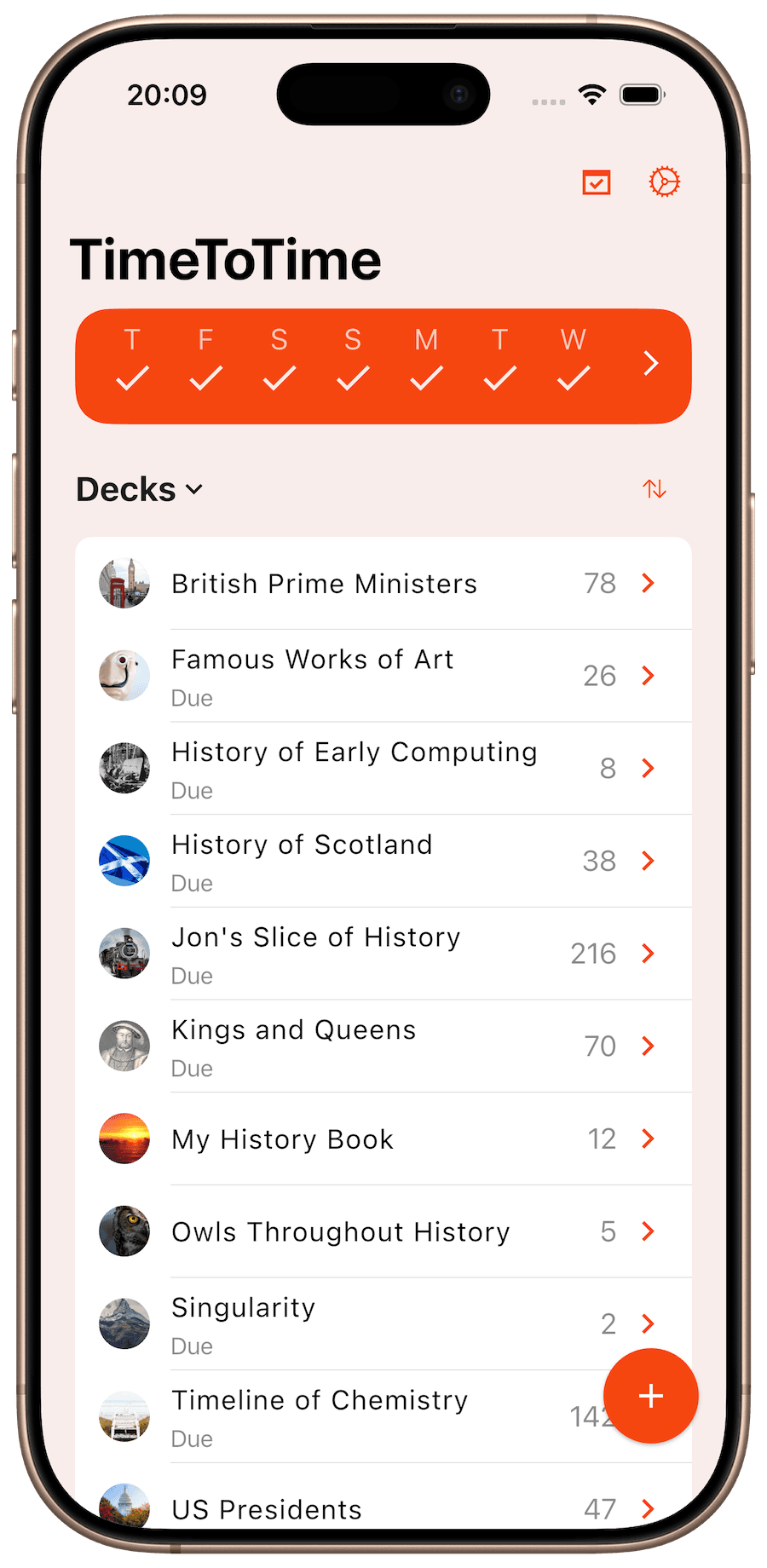
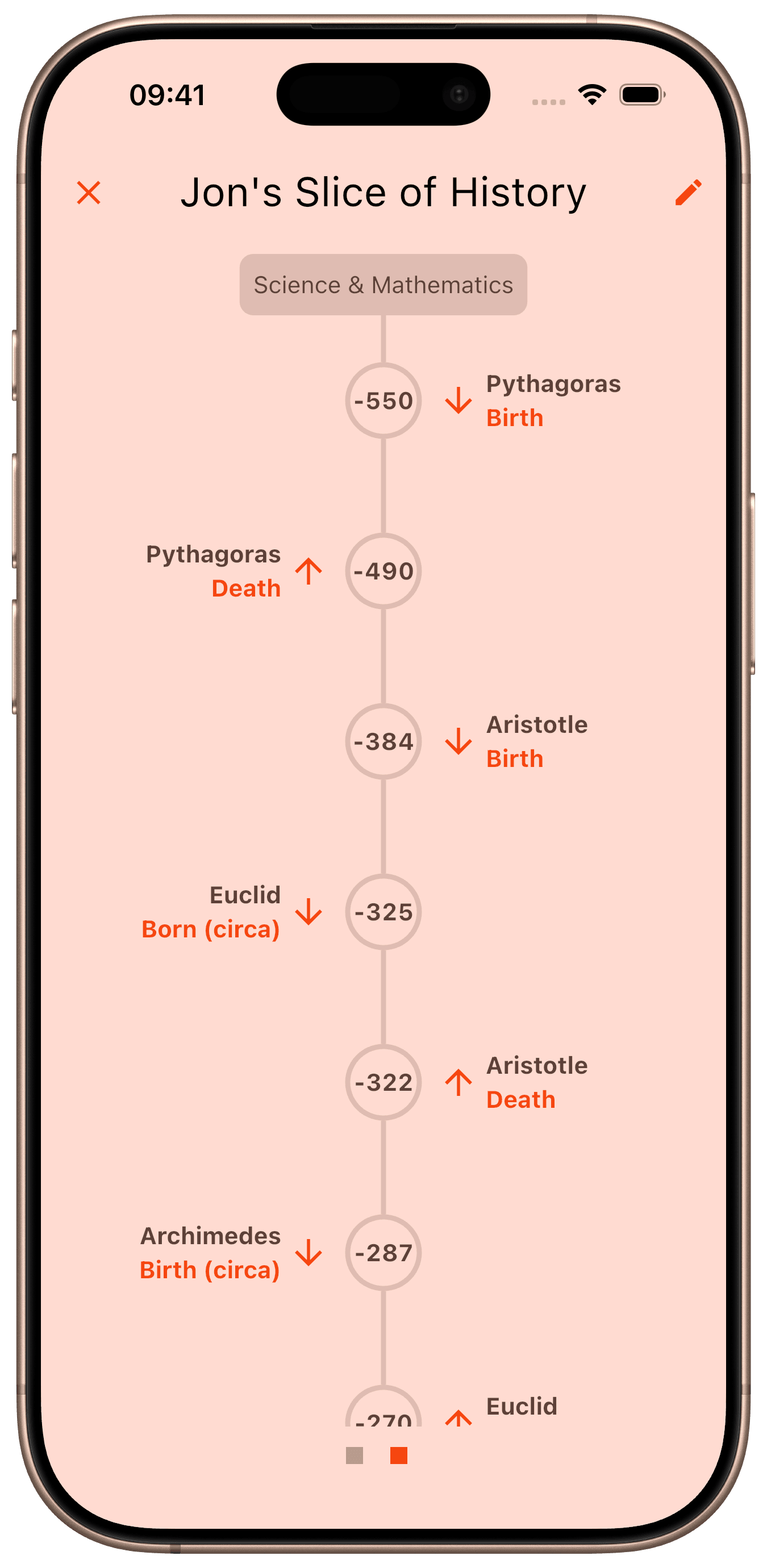
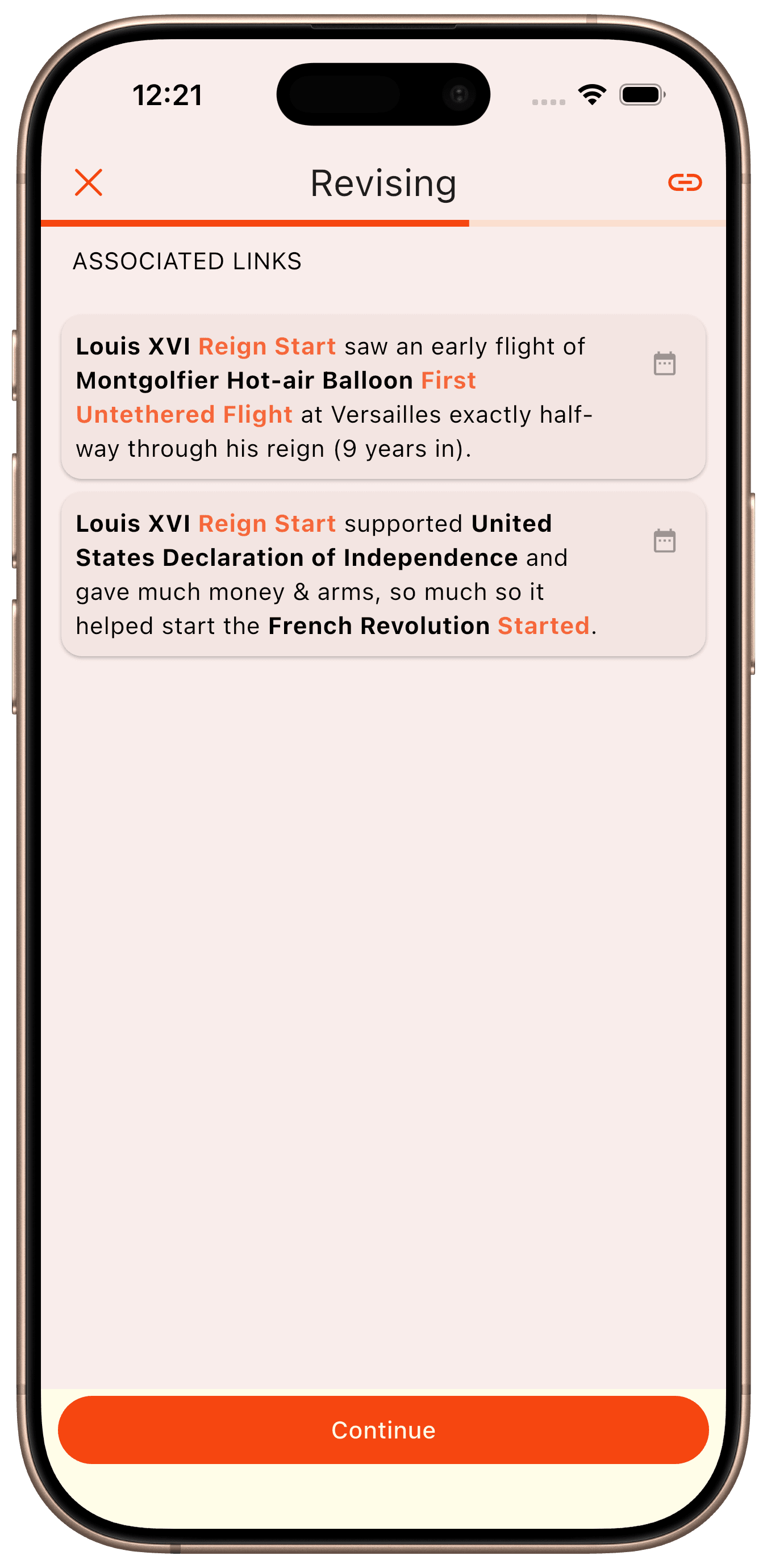
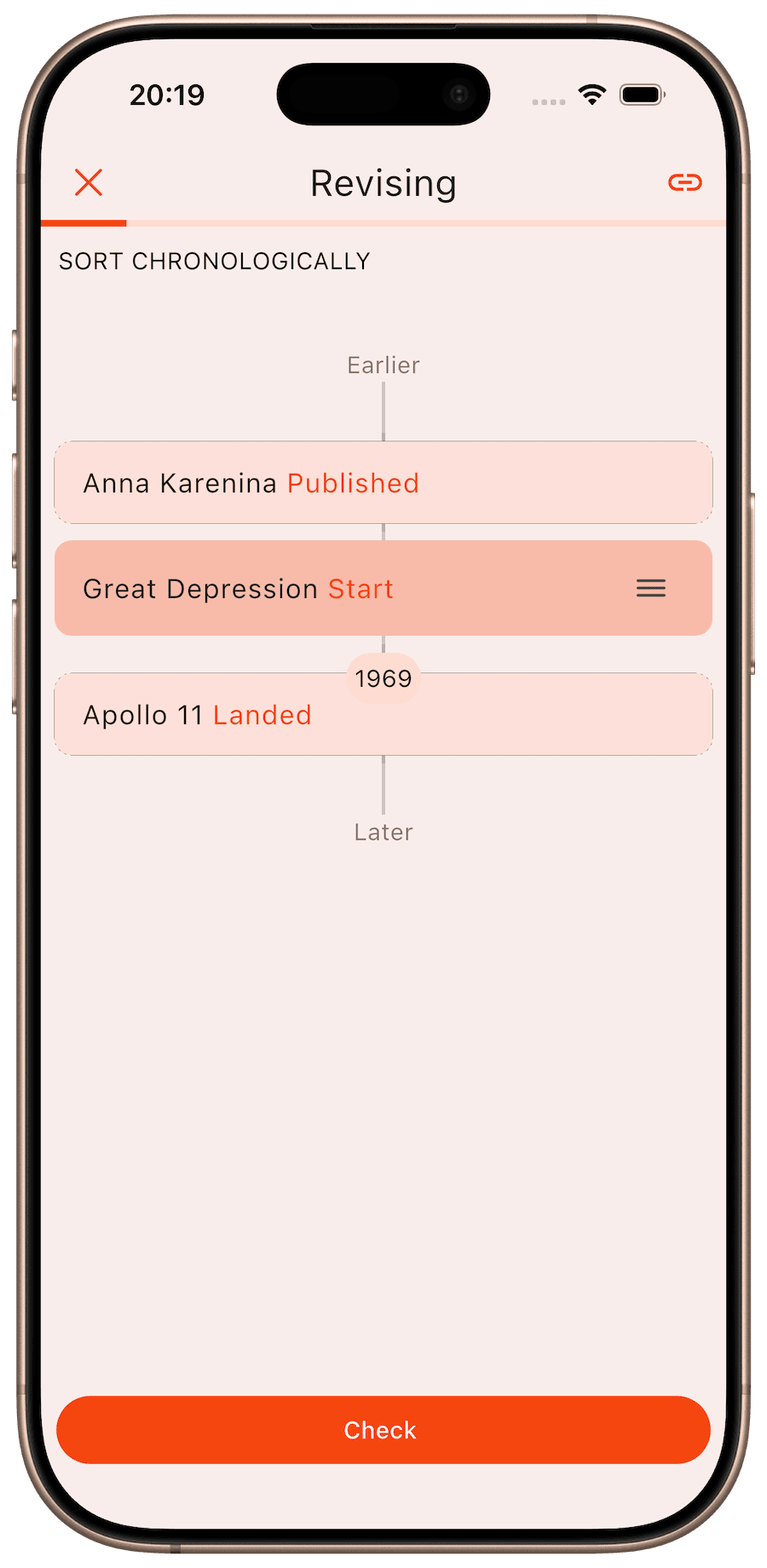
Add events and decks you encounter
Students
GCSE, A-Level and university history reward argument, not recall for its own sake. But you still need to know whether something happened in 1789 or 1791 to make that argument. TimeToTime keeps chronology and context automatic, so you spend your thinking on analysis, not on working out what came first.
For studentsHistory Enthusiasts
Years of reading leaves you with a great story but a loose grip on when things actually happened, or how a period in one country lines up with another. TimeToTime turns that reading into a durable, connected timeline you can actually place things on.
For history loversTeachers
Build a timeline for a course, publish it, and let your class subscribe. Reuse decks from the Gallery, or set up a Duel so students can practise against each other on the material you have shared.
For teachersThe problem
Most of us don't forget the story. We forget where it fits.
You probably remember who Napoleon was, roughly what the Reformation involved, and the shape of the Industrial Revolution. What's harder is placing those things relative to one another, or to events happening at the same time somewhere else. Read enough history and you end up with a rich collection of facts and a weak sense of chronology to hang them on.
TimeToTime builds that scaffolding: a connected timeline you can place new knowledge into, and dates reliable enough that you stop having to look them up.
The signature idea
History isn't a list of dates. It's a connected story.
Historical events don't exist independently — they cause, follow, echo and overlap each other. TimeToTime has a dedicated Connection feature for recording exactly those relationships between events, so your timeline stops being a set of disconnected flashcards and starts being a network you can see and reason with.
- Every event gets a place, not just a page
- A connection records why two events belong together: cause, influence, theme, or simply "around the same time". That relationship is worth keeping, so TimeToTime keeps it.
- Connections create a second way in
- If you can't recall a date directly, a connection often gets you there anyway: you remember the event it's connected to, and the relationship does the rest.
- Your timeline becomes a mental map
- As connections accumulate across a deck, isolated facts turn into a network you can see, explore and reason with, not just a list to be tested on.
One system: Build, Connect, Learn, Remember, Explore
Whichever subject you're learning — art history, world events, or the release dates of your favourite films — TimeToTime works the same way: build a timeline, connect what belongs together, and let spaced repetition make the dates reliable.
Build: create or discover a timeline
Start your own deck as you read, study, or browse, or subscribe to a deck someone else has already built and published in the Gallery.
Connect: record how events relate
Link events by cause, influence, or theme. Each connection creates an additional retrieval path, and turns a list of dates into a network you can reason with.
Learn: get acquainted with a date
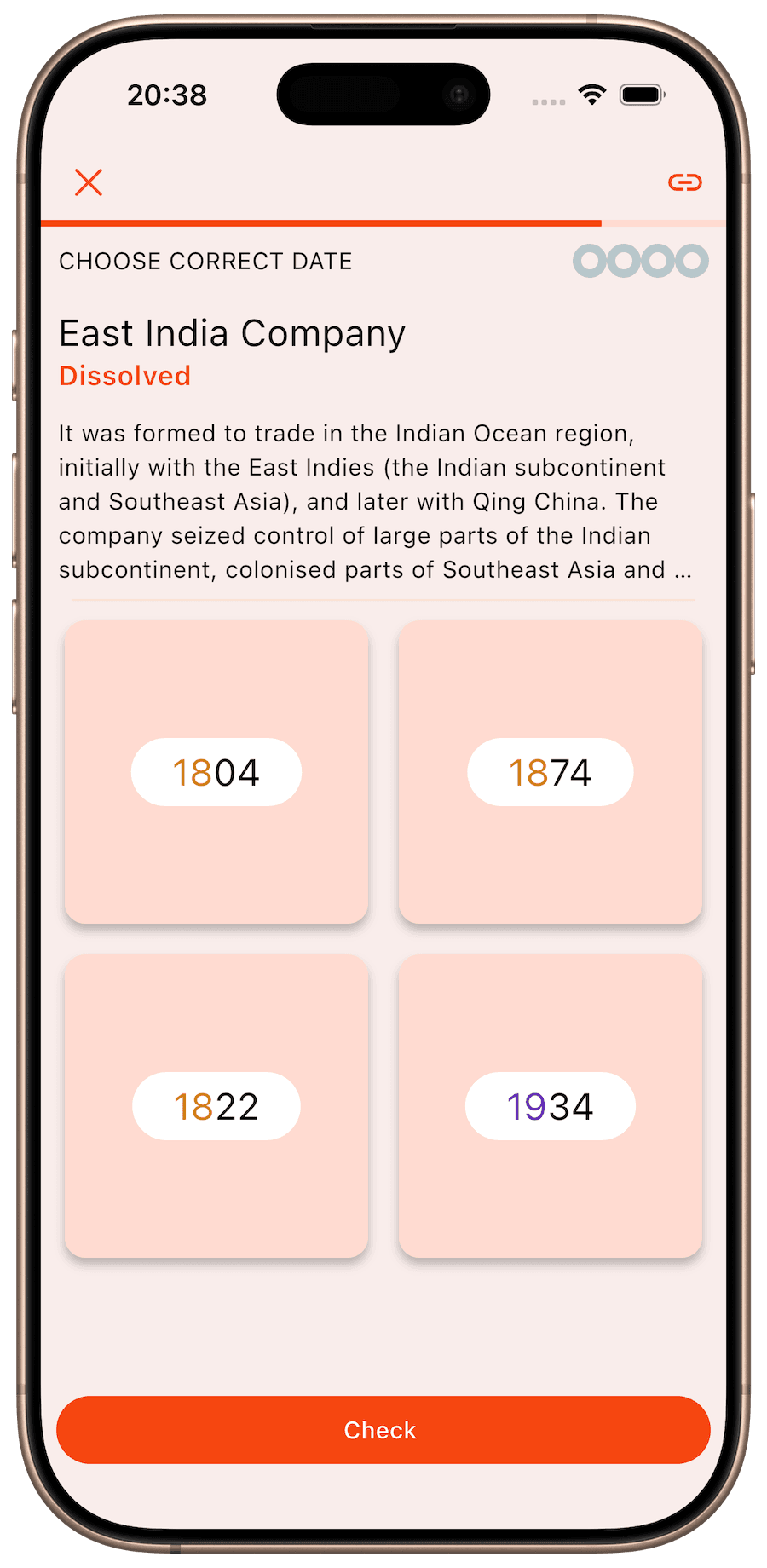
New dates are introduced gradually, and tested both contextually — before, after, between — and directly, so you build a real feel for a date, not just a guess.
Remember: spaced repetition keeps it there
Once a date is familiar, reviews are scheduled just before you would forget it, so effort goes into maintaining memory, not rebuilding it from scratch.
Explore: see the shape of what you know
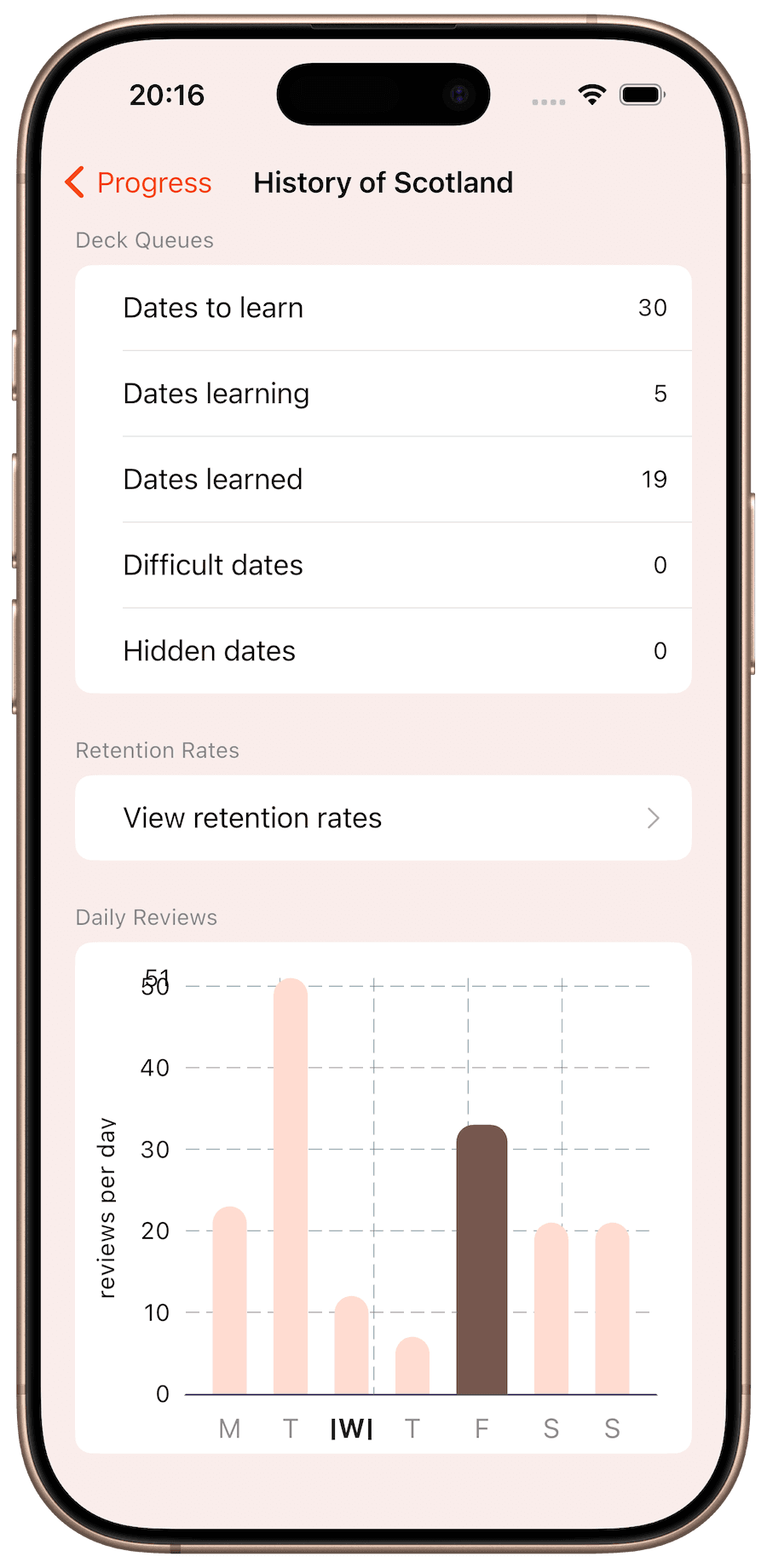
Visual timelines and connected decks let you browse your growing mental map, compare periods side by side, and track progress across everything you are learning.
History isn't about memorising dates. So why memorise dates?
Correct
History isn't about memorising dates.
Historical understanding is about causes, consequences, change and continuity, comparison, and interpretation. A list of years, on its own, explains nothing.
But
Dates are the framework those relationships sit on.
You can't reason about cause and consequence if you're not sure which event came first. When the framework is automatic, you can think about history instead of repeatedly reconstructing it.
So
Dates support understanding. They don’t replace it.
Immediate recall frees working memory for argument: placing evidence in context, comparing periods, and writing with precision, instead of stopping to check when something happened.
Connections give you the understanding. Automatic recall makes that understanding usable →
Built to fit around how you already learn
On top of connected timelines and spaced repetition, these details make TimeToTime easy to sustain day to day.
Flexible Learning
As you read a book, attend a course, listen to a lecture, or just come across an interesting connected event as you browse Twitter—quickly add the dates that matter to your decks, with a short description.
Short Learning Sessions
TimeToTime will guide you in your learning. Not too much each day, as that's confusing. Not too little each day, as that won't help consolidation. Just enough. (It's time-boxed!)
Read how this worksEasy Progress
TimeToTime strives to make your life easy. You still have to put in the work and learn each day, but TimeToTime tries to make that work effective, uncomplicated and straightforward.
Shared Decks
You can create a deck of events (with connections) and share it with others, perhaps in the same study group. Or you can subscribe to shared decks that others have created.
Practice with Others
From time to time, challenge your friends to a duel over a shared learning deck. You'll each be able to measure progress during a timed, randomised test session.
From the Gallery
See it working on real material
Every deck below was built by someone using TimeToTime — subscribe to one, or use it as a model for your own.
Jon's Well-Connected History
Important dates throughout Western civilisation, linked into one connected timeline.
View deck →AP Art History
Advanced Placement Art History (APAH) timeline
View deck →AQA Health and the People
A companion learning deck for the GCSE exam topic, built and shared by a teacher.
View deck →Watch Manufacturers & Brand Origins
Major watch brands and their commonly cited founding years.
View deck →Why not just use Anki?
A great tool for facts. A different tool for history.
Anki is excellent at generic memorisation, and we love it. If you only need one isolated fact, it's probably enough. TimeToTime is purpose-built for chronology: it's for learning where events sit in history, and how they relate to one another.
| Generic flashcards / Anki | TimeToTime |
|---|---|
| Independent facts on separate cards | Events situated within a timeline |
| Generic question/answer retrieval | Chronology-specific practice: before, after, between, exact year |
| Relationships between facts are implicit | Explicit connections you record between events |
| Little or no temporal visualisation | Visual timelines you can browse and compare |
| Excellent for isolated facts | Built to combine historical understanding with date recall |
Insights Library
The thinking behind the app.
Practical guides on memory, timeline intuition, and how to use TimeToTime features together.
8 min
TimeToTime for IB History Learners
A complete IB-focused guide for students and teachers using TimeToTime to support inquiry, not just recall.
Read insight
7 min
Why Dates Still Matter in Modern History Education
Modern history teaching rightly emphasises argument over rote learning. Here is the case for why reliable date recall still helps that argument.
Read insight
6 min
Do I Really Need the Year?
We need more than recall. We need to situate events in their wider settings and test claims against chronology.
Read insight
Simple, Transparent Pricing
Start free, then choose the plan that works for you
Plans
Monthly
$2.99
USD / mo
- Unlimited learning
- Full mobile app access
- Access to public decks
- App updates
- 3 Mnemonic Scenes a day
- 1 AI-generated timeline a day
Why we charge
Sustainability
- We want to ensure that TimeToTime.app continues to evolve to meet your needs, without uncertainty in our future about alternative funding or hidden costs. Minimal, recurring subscription pricing, helps us achieve this.
Privacy and Selling Users
- We are a principled company, very much against hidden costs and hidden ways of taxing users by selling their data. At TimeToTime, your data is your data, and we don't need to sell it, or you.
Team
- We are a small, committed team. We have big plans for the future, and having a secure, sustainable way to achieve them via a subscription model, lets us go out and do the work in helping all of you achieve your learning goals.
Frequently asked questions
Frequently Asked Questions
If you can't find what you're looking for, email us at feedback@timetotime.app with any questions.